UI Inspection
From Subjective Feedback to Faster UI Reviews
"We fixed it, but it still comes back in review." "Looks good on my screen" vs "fails on mine."
These are the kinds of comments every product team knows too well. The problem is rarely difficult code. More often, the issue is missing context.
Why UI reviews become slow
UI reviews usually get stuck for the same reasons.
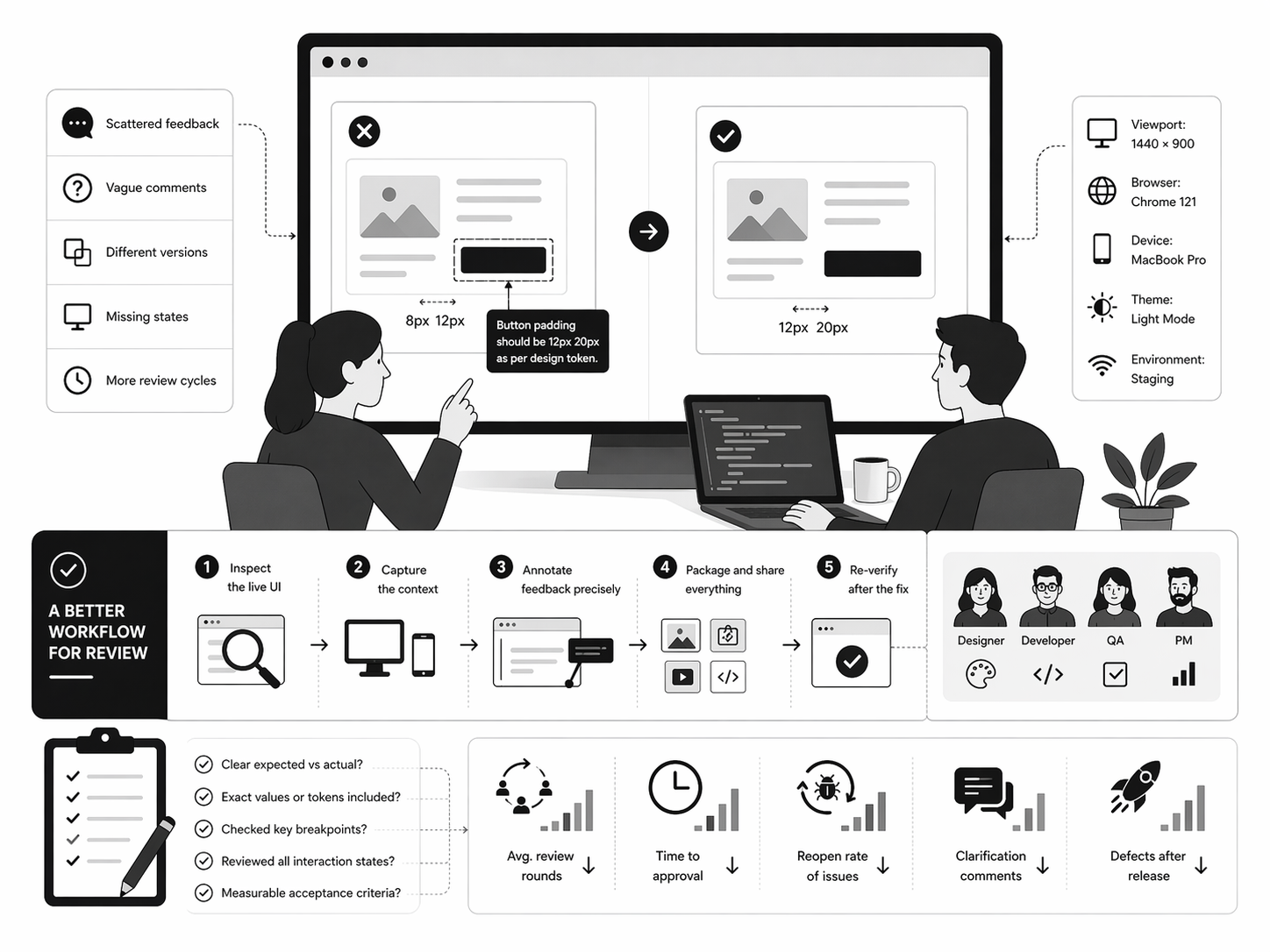
Feedback is scattered across Slack, screenshots, and issue trackers. Comments do not include exact values, states, or reference points. Different people review different versions of the same screen. Responsive and interactive states are often skipped in the first pass.
The team is not really reviewing the same thing. They are reviewing different snapshots of the UI, which creates confusion and delays.
What faster review actually means
Faster UI review does not mean fewer checks. It means a higher-quality first review.
A good review includes:
- clear expected versus actual behavior
- shared evidence from the live UI
- enough context to reduce ambiguity
- fewer cycles before merge
When the team has the same evidence and the same criteria, approval becomes much easier.
A better workflow for review
- Inspect the live UI: Check spacing, typography, color, layout behavior, and state in the browser using live UI inspection and typography inspection where text is part of the issue.
- Capture the context: Include viewport, browser, device, page state, and environment details.
- Annotate feedback precisely: Tie notes to elements and values, not vague observations.
- Package and share everything: Keep screenshots, recordings, and technical signals in one place.
- Re-verify after the fix: Check the same viewport and state before closing.
A checklist for teams
- Is there a clear expected versus actual statement?
- Are exact values or token references included?
- Was the issue checked at key breakpoints?
- Were hover, focus, disabled, and error states reviewed?
- Is the acceptance criteria measurable and testable?
What each role should do
- Designers should connect feedback to tokens and components, not only visuals.
- Developers should verify computed styles (often via CSS inspection on the live page) and responsive behavior before handoff.
- QA should validate acceptance criteria in exact target states.
- PMs should hold the line on reproducible context before approval.
How to know it is working
You can measure progress with a few simple signals:
- average number of UI review rounds per ticket
- time from first review comment to final approval
- reopen rate of resolved UI issues
- clarification comments per issue
- defects found after release versus before merge
Final thought
Faster UI reviews come from better evidence and shared criteria, not from rushing. When teams inspect the live UI, capture the right context, annotate precisely, and verify in the same state, review cycles shrink naturally.